# ComfyUI-H3-PowerLoraStack
Stacked multi-LoRA loading for **MiniMax H3**. Quantized bases keep an exact
runtime branch, AdaLN pairs are rebased between dense and curve checkpoints, and
Acc/PDD head banks are blended per sampler step instead of crashing the native
head.
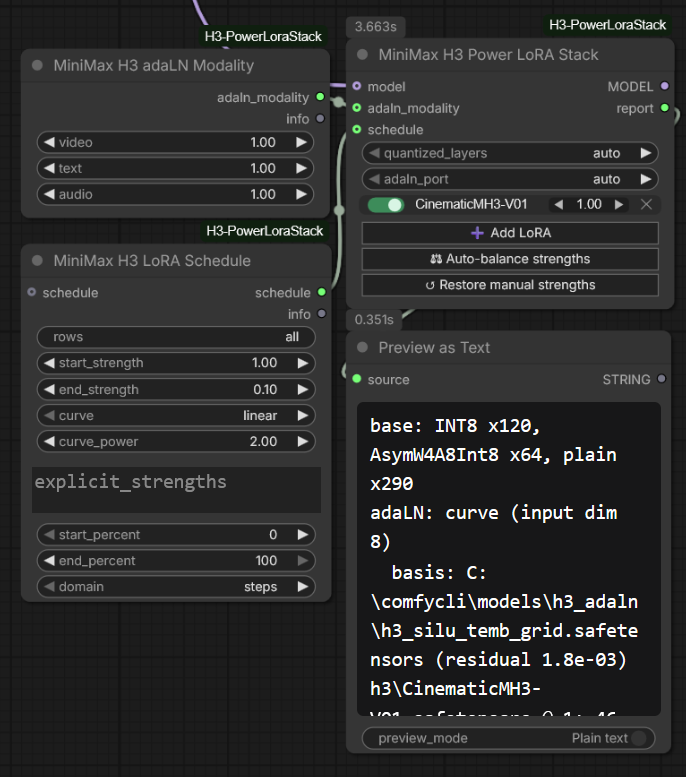
## Nodes
| Node | Purpose |
| --- | --- |
| **MiniMax H3 Power LoRA Stack** | Any number of LoRAs on one node, each with a toggle and strength, plus one-click strength calibration |
| **MiniMax H3 adaLN Modality** | Scales stacked LoRAs' adaLN modulation per modality (video / text / audio) |
| **MiniMax H3 LoRA Schedule** | Varies selected stack rows' strength over denoising steps or normalized sigma |
| **MiniMax H3 LoRA Inspector** | Reports a LoRA's format, rank and adaLN basis without loading it |
The stack row UI matured from [rgthree-comfy](https://github.com/rgthree/rgthree-comfy)'s Power Lora Loader.
## Good to know
- **AdaLN port — 8 Aug 2026, commit `28ac439`.** This stack rebases dense↔curve
AdaLN LoRA pairs so ComfyUI does not skip them with
`ERROR lora ... adaln_proj.linear.weight shape '[96768, 8]' is invalid for input of size 260112384`.
The port keeps rank and restores the DC term as a bias delta. A separate
AdaLN-fix node on the same `MODEL` is not needed; if one is already attached
the report tells you to disable it (`adaln_port=off` only if you mean to keep
that other node).
- **`quantized_layers=auto`** branches quantized weights and merges the rest.
Stock dequantize/requantize merge destroys small H3 LoRAs.
- **Strength 1.0 is not a unit.** Auto-balance only ever trims outliers; it
never boosts a quiet (e.g. turbo) LoRA.
- Empty stack rows still run the incoming AdaLN pass, so the node can sit after
another loader as a fix.
- Wire the `report` output to a show-text node (it is also logged).
Quantized weights
ComfyUI's stock path is dequantize → add delta →
`requantize_from_float(scale="recalculate")`. That round trip is not
idempotent: re-fitting the codebook and re-rounding to int4 injects ~1.5%
relative weight noise, while a typical H3 LoRA delta is 0.01–0.08% of the
weight. On a w4a8 checkpoint the stock merge recovers under a third of the
LoRA magnitude (cos 0.12–0.14) and takes 128 s versus 6.5 s.
This node routes quantized layers through an exact runtime low-rank branch
(`y = W_q(x) + B @ A @ x`), keeping the quantized kernel (~1.5% extra FLOPs at
rank 64).
`quantized_layers`:
- `auto` (default) — branch quantized layers, merge unquantized ones
- `branch` — never modify a weight, even in bf16; adapters without a runtime
branch are reported as rejected
- `merge` — stock behaviour; only useful for comparison
`mlp.fc2` under `TensorWiseINT8Layout` is reached through
`comfy.ops.linear_input_act`, which never calls `fc2.forward`. A branch there
would be dropped, so those layers merge even in `branch` mode.
AdaLN basis (dense ↔ curve)
H3 ships in two forms. A *dense* checkpoint feeds `silu(time_embedder(t))`
(2688-wide) into every `adaln_proj.linear`. A *curve* (pruned) checkpoint
stores `adaln_t_table` of shape `[grid, 8]` and drops the time embedder.
A LoRA trained on one form has the wrong `lora_A` width for the other. ComfyUI
logs the shape error above and skips the layer. Dropping those pairs is not an
acceptable fix: on turbo distillation LoRAs the constant term alone is ~100% of
`dW @ S(t)`.
This node changes basis and preserves rank:
```
dense -> curve A' = A @ V, bias delta B @ (A @ c)
curve -> dense A' = A @ pinv(V), bias delta -B @ (A' @ c)
```
`S(t) = c + V @ table(t)` is recovered by least squares of `[1 | table]`
against the silu grid. The bias is emitted as `.diff_b`. End-to-end, the
ported adapter matches the dense contribution at **cos 0.999998**.
The fit uses the *target checkpoint's own* table. Bakes differ: one local bake
is uncentered (column norms 22.98, 2.67, 1.66, …), another is mean-centered
(7.08, 2.09, 0.75, …).
Two curve bakes can share AdaLN width, so a LoRA trained on one loads on the
other without complaint and is simply wrong (measured **cos −0.375**). When a
LoRA ships `adaln_t_table`, this node rebases table-to-table (cos 1.000000, no
grid). When it does not, prefer LoRAs trained against the checkpoint you run.
Incoming patches on `MODEL` are scanned by shape and rebased the same way,
still as a rank decomposition plus `.diff_b`. `adaln_port`: `auto` (default),
`strip` (drop mismatched pairs), or `off`.
**Grid sources.** Prefer a basis baked into the checkpoint (`adaln_basis` +
`adaln_mean`, or `silu_t_emb_grid`). Else a live `time_embedder` on a dense
base, then `h3_silu_temb_grid.safetensors` (`models/h3_adaln/`, `models/loras/`,
`models/diffusion_models/`, one level under `custom_nodes/`), then a scored
scan of other H3 checkpoints. Table-to-table needs no grid. A grid from the
wrong build bottoms out at ~1.7e-3; fits worse than 5e-3 are rejected.
Key conventions
Keys resolve against the model's own state dict, not by guessing underscore
splits (`qkv_proj` is never two tokens):
| Convention | Example |
| --- | --- |
| ai-toolkit / diffusers | `diffusion_model.blocks.0.attn.qkv_proj.lora_A.weight` |
| bare (no prefix) | `blocks.0.attn.qkv_proj.lora_A.weight` |
| kohya / musubi | `lora_unet_blocks_0_attn_qkv_proj.lora_down.weight` + `.alpha` |
| lycoris | `lycoris_blocks_0_...` |
| peft / diffusers trainer | `base_model.model.blocks.0...`, `transformer.blocks.0...` |
Unmatched keys are reported per row.
Acc / PDD output heads
alibaba-pai Acc LoRAs ship a 32-interval output-head bank as
`final_layer.video_out.set_weight` of shape `[3072, 5376]` (`32 × 96`) plus the
audio twin. Stock Comfy `copy_`s that onto the native `[96, 5376]` head and
crashes. This node peels those tensors before the stock `set` path and blends
the heads the sampler step spans: row 0 is the full head and later rows are
offsets from it. Original `proj_out` banks are full heads, so those are
converted to that layout first. Row strength
interpolates between native and blended heads; schedules multiply that
strength. Use `simple` at 8 steps with shifts 12/3 so steps land on the trained
grid. Later stack rows that also carry a bank replace the earlier one.
Stacking
Multiple LoRAs on the same layer fuse into one pair by concatenating along the
rank axis:
```
sum_i s_i * B_i @ A_i @ x == [s_1 B_1 | ... | s_N B_N] @ [A_1; ...; A_N] @ x
```
A ten-LoRA stack costs one extra matmul pair per layer, not ten. Factors live
in a bank registered via `set_additional_models` so VRAM is accounted for.
Denoising schedules
Wire **MiniMax H3 LoRA Schedule** into the stack. Select rows with `all`,
`1,3`, or `2-4`, then a linear, cosine, smoothstep, power, step, or explicit
curve. `start_percent` / `end_percent` limit the transition. Chain schedule
nodes; the later node wins where selectors overlap.
`steps` follows model-call indices. `sigma` follows the scheduler's normalized
noise. The stack reads `sample_sigmas` from ComfyUI; plain KSampler works, no
SIGMAS wire.
Scheduled rows always use the live branch path, including on unquantized
bases. Anything that cannot branch is merged at the row's static strength and
called out in the report. Ported AdaLN bias deltas follow their LoRA rather
than staying fixed.
Auto-balance
In the reference non-distillation H3 corpus, perturbation at strength 1.0 spans
**65×** (0.054% of base weights vs 5.24%). Rank and file size do not predict
it. `⚖ Auto-balance strengths` measures each active LoRA and puts them on one
scale:
```
rel = sqrt( sum_l ||dW_l||_F^2 / sum_l ||W_l||_F^2 )
```
The factor multiplies the strength you already chose, so relative intent
between rows survives. It is clamped to ≤ 1 (trim only). Distillation adapters
are quiet on purpose and stay at ×1.00.
`dW` is never formed. `||B A||_F^2 = tr((B^T B)(A A^T))` uses r×r matrices.
Results cache on (path, mtime, size). LoKr: `||W1 ⊗ W2||_F = ||W1||_F · ||W2||_F`.
The reference is the collection *median*. AdaLN is excluded from the
measurement (basis is checkpoint-dependent; distillation keeps the schedule
change there). `↺ Restore manual strengths` puts every row back; editing a
strength by hand is not clobbered by a later recompute.
Frobenius energy is not perceptual strength, and it says nothing about
contention. Distinct LoRAs are near-orthogonal in weight space
(|cos| ≤ 0.03) yet overlap 3–15× above chance in feature subspaces. Stack
energy adds in quadrature (`1/√N`, not `1/N`); auto-balance does **not** apply
that — adding a row never silently weakens the others.
AdaLN modality control
H3 packs audio and video through the same 50 blocks. The only modality-specific
weights are four tensors (`video_patch_proj`, `audio_patch_proj`,
`final_layer.video_out`, `final_layer.audio_out`), and typical H3 LoRAs touch
none of them.
AdaLN does split: `AdalnProj` emits three contiguous blocks of 32256 rows
(`{video: 0, text: 1, audio: 2}`). Scaling a slice of `lora_B` scales that
modality's modulation with no runtime hook.
Wire **MiniMax H3 adaLN Modality** into `adaln_modality`. All three at 1.0 is a
no-op; 0.0 removes that modality's share. Scaling runs *before* AdaLN porting
so `.diff_b` inherits it. Geometry is read off the loaded `AdalnProj`;
`final_layer.adaln_proj` is one-modality and is left alone.
Where AdaLN is present it is not a marginal knob: 89–99.7% of weight-space
perturbation for content LoRAs (median ~96%), 16–23% for curve8 turbo
adapters. Read that as where most of the weight change lives, not as 96% of
what you see.
Report output
```
base: ConvRotW4A4 x300, INT8 x50
adaLN: curve (input dim 8)
turbo dense-adaLN @ 1: 26 merged, 275 branched, adaLN ported x51 (basis fit 1.7e-03)
rel dW 0.047%
style_lora curve-adaLN @ 0.8: 0 merged, 258 branched, adaLN modality video/text/audio = 1/1/0.25 x50
rel dW 0.054%
motion_lora @ 1: 0 merged, 104 branched, adaLN modality 1/1/0.25 INACTIVE (LoRA has no adaLN pairs)
rel dW 0.316%
branch bank: 300 layers, 412 MB
```
`rel dW` is reported for every LoRA whether or not auto-balance ran. When the
applied strength is far from the calibrated one, the line says what
auto-balance would have used.
Limitations
- A curve-trained LoRA on a **dense** checkpoint can only be ported if the LoRA
carries its own `adaln_t_table`; otherwise those AdaLN pairs are dropped with
a warning.
- Runtime branches apply to `MODEL` from ComfyUI's native H3 loader. The
streaming loader in `minimaxh3chinkloader` uses its own handle and LoRA path.
- DoRA, LoHa, LoKr and locon merge in `auto`; `branch` rejects them (only plain
rank decompositions have the runtime branch path).
Development checks
From the ComfyUI root:
```powershell
$env:PYTHONPATH = "custom_nodes/ComfyUI-H3-PowerLoraStack;."
python -m pytest custom_nodes/ComfyUI-H3-PowerLoraStack/tests --import-mode=importlib -q
```
CPU paths are covered; the mixed-device check skips without CUDA.
`node --check web/h3_power_lora_stack.js` validates the frontend.
Requires Python 3.10+ and a ComfyUI revision with MiniMax H3,
`QuantizedTensor`, weight adapters, and patcher wrappers.
## License
Licensed under the [Apache License, Version 2.0](LICENSE).