 BehzadandClaude Sonnet 5
c1d905ad52
The template browser showed a placeholder gradient for all five templates
because ComfyUI looks for a thumbnail with the same basename as the workflow
JSON and there wasn't one. Adds workflows/<name>.webp for each: a 7-frame loop
of one style applied to seven different subjects, which is the product claim
stated visually rather than in prose.

Thumbnails are 400x400 rather than the source 800x800 — 64 KB each instead of
339 KB. These install onto every user's machine, and 1.7 MB of artwork on a
78 KB pack is the wrong trade for pixels that render at a couple of hundred
pixels wide.

The README gains the full-size loop and a gallery shot. Both live in assets/
and are referenced by absolute URL, so GitHub and the Registry render them
while .comfyignore keeps the bytes out of the install.

Co-Authored-By: Claude Sonnet 5 <noreply@anthropic.com>
179 lines
8.0 KiB
Markdown
179 lines
8.0 KiB
Markdown
# StyleRef nodes for ComfyUI
|
|
|
|
<img src="https://raw.githubusercontent.com/StyleRef/styleref-comfyui/main/assets/workflow.webp" alt="One StyleRef style applied to seven different subjects" width="420" align="right">
|
|
|
|
Define a creative style once on [StyleRef](https://styleref.io) — colors,
|
|
lighting, mood, composition, guardrails — then load it as a node and reuse it
|
|
across your workflows.
|
|
|
|
Every frame on the right is the same style, a different subject.
|
|
|
|
The style is compiled server-side for whichever model you point it at, so the
|
|
same style produces prompt text phrased appropriately for each one.
|
|
|
|
**No account needed** to load and apply public gallery styles. An account adds
|
|
your own private styles. **Nothing in this node pack spends credits.**
|
|
|
|
---
|
|
|
|
## Install
|
|
|
|
**ComfyUI Manager** (recommended) — search for **StyleRef** and click Install.
|
|
|
|
**Manually:**
|
|
|
|
```bash
|
|
cd ComfyUI/custom_nodes
|
|
git clone https://github.com/StyleRef/styleref-comfyui
|
|
```
|
|
|
|
Restart ComfyUI. No dependencies to install — the pack uses only the Python
|
|
standard library. Look for `[StyleRef] v1.0.2 — 5 nodes registered` in the
|
|
server console at startup.
|
|
|
|
## 60-second quickstart
|
|
|
|
1. Add **StyleRef Load** and paste a slug from the
|
|
[gallery](https://styleref.io/gallery) into `style_ref` (try
|
|
`72e1zdae-e2d54a18d090`, the Noir Low-Key Portrait style) — or click
|
|
**Search styles…** to pick one.
|
|
2. Add **StyleRef Apply**, connect `style`, type a subject, pick your target.
|
|
3. Wire `positive` / `negative` into your CLIP Text Encode nodes.
|
|
|
|
Or drag [`workflows/01-quickstart.json`](workflows/01-quickstart.json) onto the
|
|
canvas.
|
|
|
|
## Nodes
|
|
|
|
| Node | Sign-in | What it does |
|
|
| --- | --- | --- |
|
|
| **StyleRef Load** | No | Fetch a style by share slug or share URL — and, signed in, your own private styles by id or `/styles/{id}` URL. Names the loaded style on the node, plus gallery search with a picker dialog and a ↻ Refresh button. |
|
|
| **StyleRef Apply** | No | Compose a subject with a style into `positive` / `negative` prompts for a chosen target, with a prompt preview in the node body. |
|
|
| **StyleRef Facets** | No | Every schema section as its own output — exactly the style board's section list, plus the six custom style items. |
|
|
| **StyleRef Reference Images** | No | The style's inspiration images as an IMAGE batch — for IPAdapter and reference conditioning. |
|
|
| **StyleRef Login** | — | Status line + Sign in / Sign out buttons. Needed only to load your own private styles. |
|
|
|
|
### Targets
|
|
|
|
`ai_tools`, `style_md`, `flux`, `midjourney`, `diffusion`, `json` — exactly the
|
|
web app's copy-box format list. For the sampler in your graph use `flux` (FLUX
|
|
models) or `diffusion` (SDXL, SD1.5, DALL·E-class); the other four are for
|
|
copying the output out of ComfyUI, and the node warns if one feeds a CLIP
|
|
encoder.
|
|
|
|
### Browse the gallery
|
|
|
|
[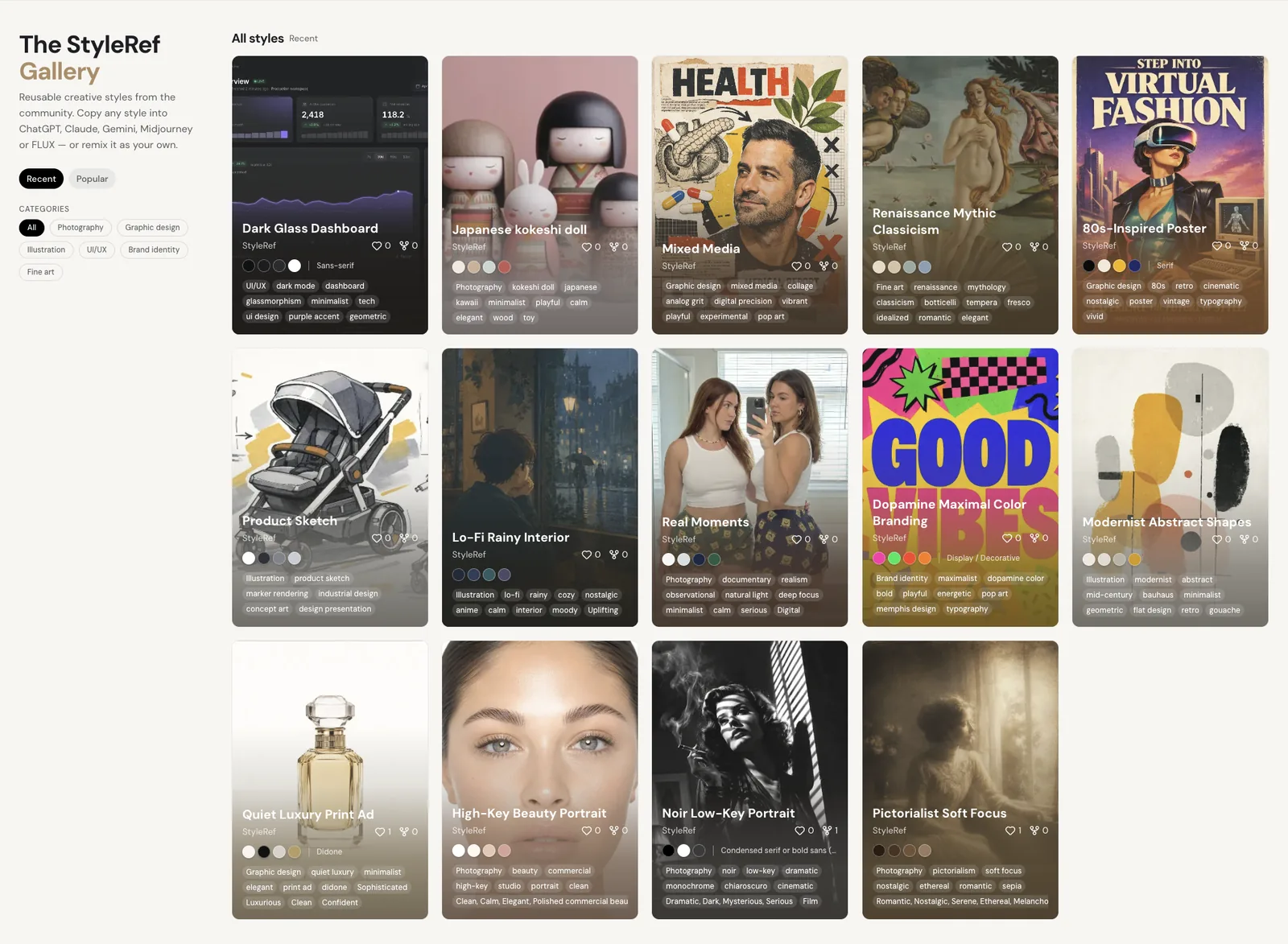](https://styleref.io/gallery)
|
|
|
|
Every style on [styleref.io/gallery](https://styleref.io/gallery) loads here by
|
|
its slug — no account needed.
|
|
|
|
### Making your own styles
|
|
|
|
Extraction (turning an image into a style) happens on
|
|
[styleref.io](https://styleref.io) — upload an image there, refine the result,
|
|
and it lands in your library. Load it here by its share slug or id
|
|
(sign in with the Login node first).
|
|
|
|
## Workflow templates
|
|
|
|
The templates at the root run on **FLUX.1 dev** (the Comfy-Org fp8 all-in-one
|
|
checkpoint, downloaded on first queue). FLUX reads the prompt with T5, so a
|
|
full compiled style fits — an SDXL CLIP encoder truncates it at ~77 tokens,
|
|
which is why the style washes out there no matter which checkpoint you use.
|
|
|
|
| File | Sign-in | Story |
|
|
| --- | --- | --- |
|
|
| [`01-quickstart.json`](workflows/01-quickstart.json) | No | Load → Apply → generate |
|
|
| [`02-consistency-grid.json`](workflows/02-consistency-grid.json) | No | One style, three subjects, side by side |
|
|
| [`03-your-own-style.json`](workflows/03-your-own-style.json) | Yes | Extract on the web, load your own style here |
|
|
| [`04-reference-images.json`](workflows/04-reference-images.json) | No | The style's inspiration images as a batch, next to a render |
|
|
| [`05-facets.json`](workflows/05-facets.json) | No | Every section of the style as its own output, next to a normal render |
|
|
|
|
A parallel set wired for **Z-Image Turbo** (an S3-DiT model — UNET + Qwen text
|
|
encoder + VAE, compiled from the `diffusion` target) lives in
|
|
[`workflows/z-image/`](workflows/z-image): the same five stories on that
|
|
loader stack. The three model files download on first run.
|
|
|
|
The two sets load **different gallery styles on purpose.** How well a style
|
|
demos is a property of the style *and* the model. FLUX is strongest at light
|
|
and tonality, so its templates load a noir style — hard key, crushed blacks,
|
|
monochrome. Z-Image reproduces painterly technique faithfully, so its
|
|
templates load a Renaissance tempera style. Swap either for any slug from the
|
|
[gallery](https://styleref.io/gallery); these are starting points, not
|
|
limits.
|
|
|
|
**Neither FLUX nor Z-Image takes a negative prompt.** Both are guidance
|
|
distilled and run at CFG 1.0, where the negative branch is multiplied out
|
|
entirely — so neither set carries a negative encoder, and the sampler's
|
|
negative input gets a zeroed conditioning. StyleRef still compiles
|
|
the negative and previews it on the canvas; fold anything you need from it into
|
|
`subject` on Apply as a positive phrase. Raising CFG does not bring it back.
|
|
|
|
## Signing in
|
|
|
|
Add the **StyleRef Login** node and click **Sign in (browser)** — no queueing
|
|
needed. Your browser opens, you approve, and the node's status flips to signed
|
|
in. The token is stored at `~/.config/styleref/credentials.json` with `0600`
|
|
permissions. The [`styleref` CLI](https://www.npmjs.com/package/styleref)
|
|
shares this login.
|
|
|
|
(No frontend at all? `npx styleref login` signs in the same credentials file,
|
|
and queueing the Login node reports the current status.)
|
|
|
|
### Running ComfyUI on a remote or headless machine
|
|
|
|
Browser sign-in **cannot** work on a rented GPU box, RunPod, or any headless
|
|
server: there is no browser to open, and `localhost` is the wrong machine. Use a
|
|
token instead:
|
|
|
|
1. Copy a token from your [account page](https://styleref.io/account).
|
|
2. Where ComfyUI runs, set `STYLEREF_TOKEN=<token>`
|
|
3. Restart ComfyUI.
|
|
|
|
`STYLEREF_TOKEN` always takes precedence over stored credentials. The Login node
|
|
detects the headless case and prints these instructions rather than hanging.
|
|
|
|
## Credits
|
|
|
|
**Nothing in this node pack spends credits.** Loading, searching, and applying
|
|
styles is free and unlimited within the public rate limit. Extraction — the one
|
|
paid action — happens on [styleref.io](https://styleref.io), where you can
|
|
preview and refine the result before it costs anything beyond the extraction
|
|
itself. See [plans and limits](https://docs.styleref.io/using-styleref/plans-and-limits).
|
|
|
|
## Configuration
|
|
|
|
| Variable | Purpose |
|
|
| --- | --- |
|
|
| `STYLEREF_TOKEN` | Bearer token; overrides stored credentials. The headless path. |
|
|
| `STYLEREF_API` | API base URL. Defaults to `https://styleref.io/api/v1`. |
|
|
| `STYLEREF_FORCE_BROWSER_LOGIN` | `1` forces browser login, `0` forces the token path. |
|
|
|
|
## Development
|
|
|
|
```bash
|
|
pip install pytest ruff pillow numpy # pillow/numpy are test-only deps
|
|
pytest tests/ -q
|
|
ruff check .
|
|
python scripts/build_workflows.py # regenerate workflow templates
|
|
```
|
|
|
|
The workflow templates are generated — edit
|
|
[`scripts/build_workflows.py`](scripts/build_workflows.py), not the JSON.
|
|
|
|
The nodes are a thin client over StyleRef's public
|
|
[REST API v1](https://docs.styleref.io/for-ai-agents/rest-api/overview-and-authentication)
|
|
([OpenAPI](https://styleref.io/api/v1/openapi.json)). All prompt compilation
|
|
happens server-side — this pack never writes style prose itself, so improvements
|
|
to StyleRef's compiler reach you without an update to this pack.
|
|
|
|
## Docs & support
|
|
|
|
- [ComfyUI connector docs](https://docs.styleref.io/connectors/comfyui/install-and-quickstart)
|
|
- [Issues](https://github.com/StyleRef/styleref-comfyui/issues)
|
|
|
|
## License
|
|
|
|
MIT — see [LICENSE](LICENSE).
|